
NEWS
Gibson County Covered Bridges Gain Recognition
Recent National Register listings raise awareness of the historic spans.
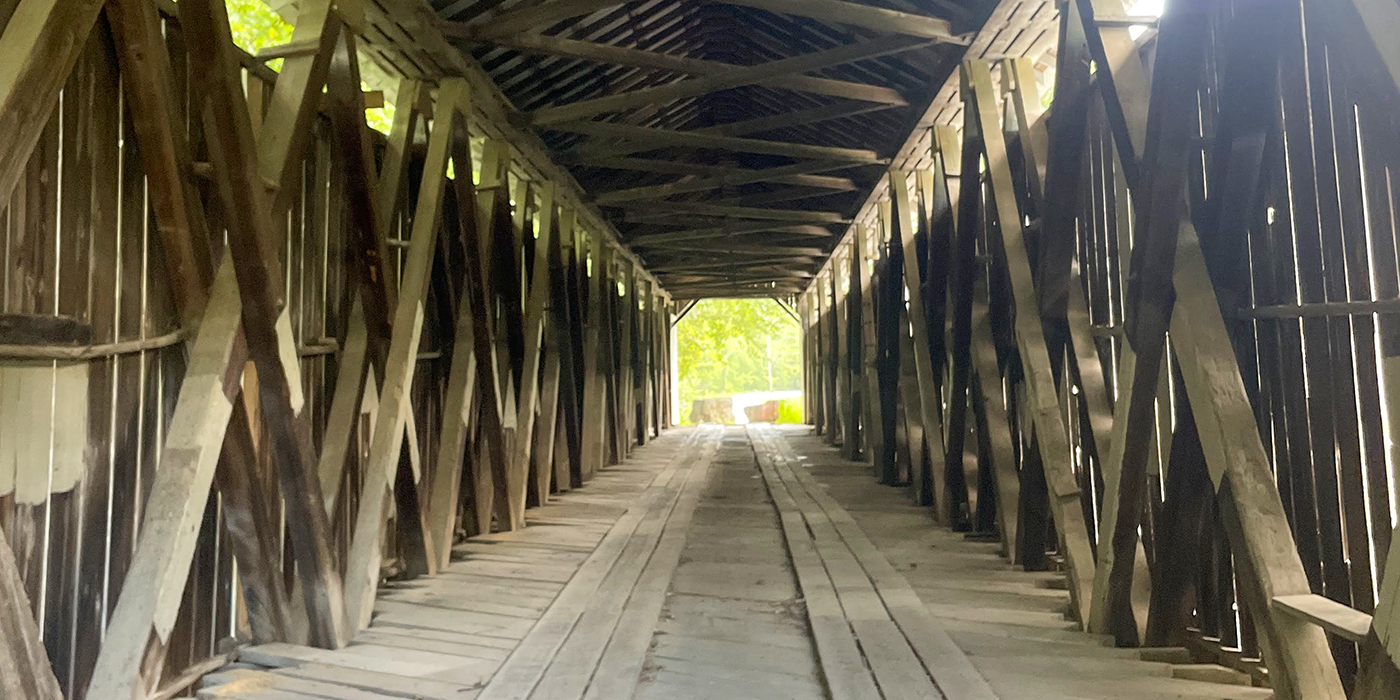
Bridging History
Recently two covered bridges in Gibson County made history for the second time as the last Indiana covered bridges still in their original location to be added to the National Register of Historic Places. Indiana Landmarks’ Historic Bridges Initiative spurred the listing. Since the 2000s, the initiative has helped support the listing of stone, iron, and covered bridges across the state in the National Register with funds provided by the Efroymson Family Fund of the Central Indiana Community Foundation. The designation draws attention to the significant role such structures once played in local communities.
Over 600 covered bridges were built in Indiana between 1820 and 1922, a number that today has dwindled to 90 according to the Indiana Covered Bridge Society, making Gibson County’s Old Red Covered Bridge and Wheeling Covered Bridge rare survivors. In 2024, Indiana Landmarks Southwest Field Office Director Stephanie Richard approached Gibson County Commissioners about nominating the bridges to the National Register, sharing the benefits and opportunities the listing provides, which includes making qualifying property owners eligible for rehabilitation tax credits and some grants. The commissioners agreed, and the Historic Bridges Initiative funded research and the nominations prepared by preservation consultant Kurt West Garner of KW Garner Consulting.
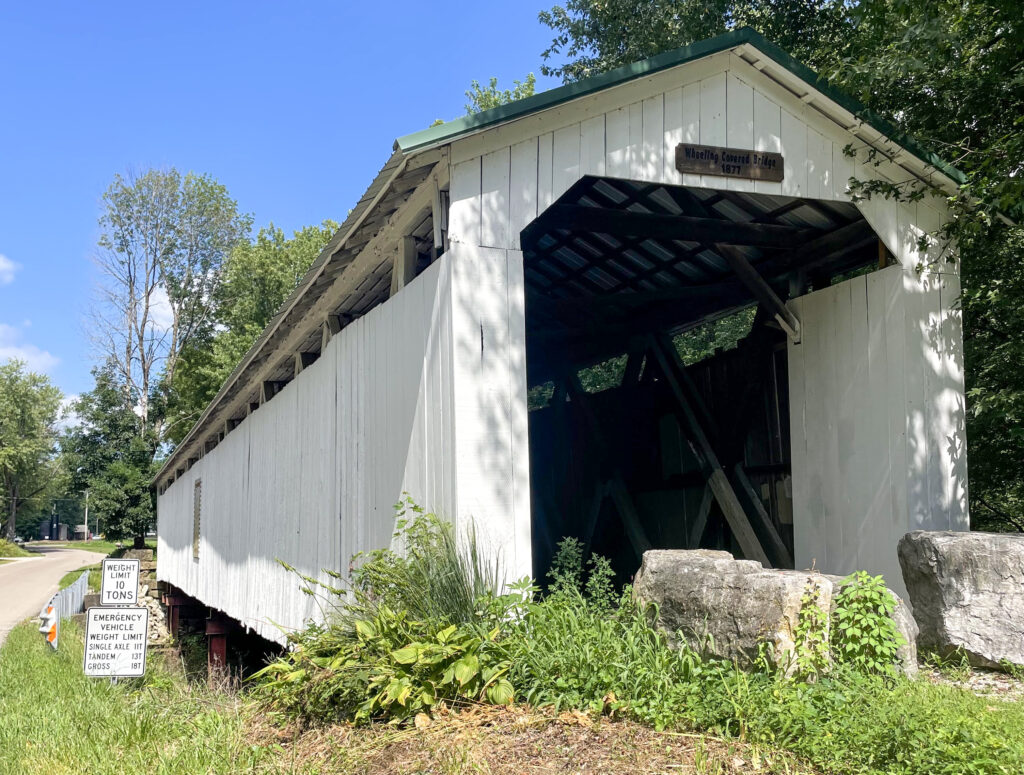
Completed in 1877, Gibson County’s Wheeling Covered Bridge recently achieved listing in the National Register of Historic Places with support from Indiana Landmarks’ Historic Bridges Initiative. PHOTO: Stephanie Richard
The Old Red Covered Bridge and Wheeling Covered Bridge were eligible for listing in the National Register for their significant role in engineering and transportation history in nineteenth-century Indiana. Both bridges are examples of the Smith Covered Bridge Truss, developed by Ohio inventor Robert Smith in 1867 and sold through the Smith Bridge Company. Smith patented a truss that, “for a short time allowed wood bridges to successfully compete with iron ones,” according to Covered Bridges and the Birth of American Engineering. The bridge components were prefabricated, shipped to the site, and then assembled by a local builder. In Gibson County and surrounding area, that was William T. Washer of Troy, Indiana.
In the case of Old Red, the frame was prefabricated in Pennsylvania, shipped to Cincinnati, and then taken by boat on the Ohio and Wabash rivers before Washer constructed the 160-foot-long-bridge in 1875 over Big Bayou Creek in Wabash Township near present-day Griffin. At the time, the structure provided a much-needed crossing to an emerging network of roads. It closed to vehicular traffic around 1980, as a new crossing was established nearby in an effort to preserve the wooden span.
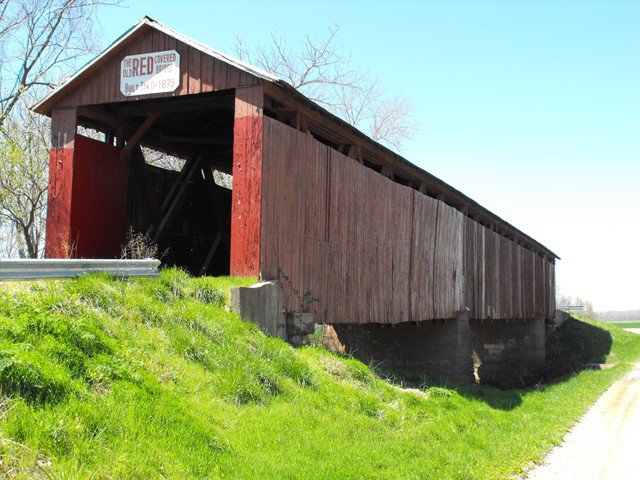
Located near Griffin, Indiana, Old Red Covered Bridge was built in 1875 to help traffic cross the Big Bayou Creek. PHOTO: Courtesy Indiana Division of Historic Preservation and Archaeology
Located near Francisco, Indiana, and stretching 163 feet long, the Wheeling Covered Bridge was built between 1876 and 1877 to provide better access over the Patoka River in Washington Township where the river frequently swelled over its banks. The Whiting quarry just north of the bridge site, which frequently shipped its sandstone down the Patoka River by flatboat, supplied the sandstone used for the bridge’s abutments and wing walls. Closed to vehicular traffic, the Wheeling Covered Bridge now serves as a pedestrian bridge.
Even though the golden era of covered bridges encompassed a relatively short period, they have left a picturesque mark on Hoosier history. Today, they are often ambassadors of historic preservation, capturing and illustrating some of the core principles of preservation: repair rather than replace, respect historic materials and craftsmanship, and balance the past with present and future needs. Restored covered bridges serve as tourist attractions and event spaces, providing economic benefit alongside scenic ties to local heritage.
To learn more about Gibson County’s historic covered bridges, including ongoing efforts to preserve and rehabilitate them, contact Indiana Landmarks’ Southwest Field Office, 812-423-2988, southwest@indianalandmarks.org.
Stay up to date on the latest news, stories, and events from Indiana Landmarks, around the state or in your area.